


Belt Conveyor Machine
Why Choose Us
Quality Control
The company has attained various certifications such as ISO9001 Quality Management System Certification.
High Quality
Our products are manufactured or executed to very high standards, using the finest materials and manufacturing processes.
Professional Team
Our professional team collaborate and communicate effectively with one another, and are committed to delivering high-quality results. They are capable of handling complex challenges and projects that require their specialized expertise and experience.
Competitive Price
We offering a higher-quality product or service at an equivalent price. As a result we have a growing and loyal customer base.
What is Belt Conveyor Machine
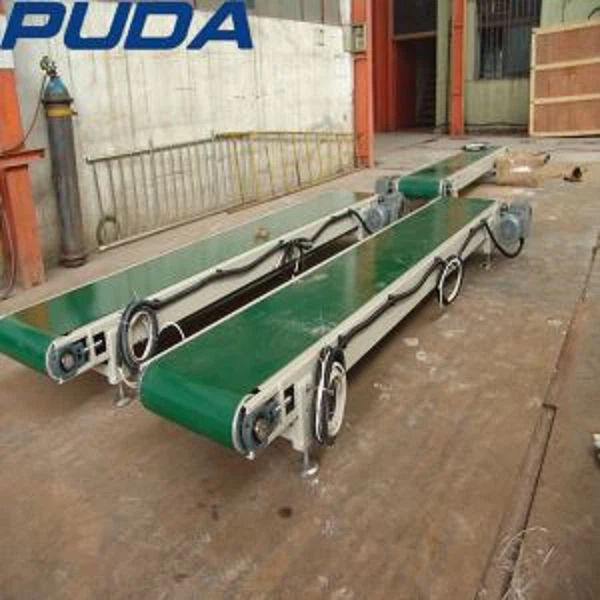
Belt conveyor machine are the most versatile and simplest material handling systems. They work with two or more pulleys driving an endless loop belt. The loop then moves a product from Point A to Point B on the belt. We use belts made from fabric or rubber. Belt conveyors are commonly used in both manufacturing and distribution facilities.
Related Product

Slat Chain Conveyor For Kinkamoa Mine
The Slat Chain Conveyor is an innovative and efficient solution for a wide range of industrial applications. This type of conveyor system is designed to move heavy loads of various sizes and shapes while offering maximum flexibility and durability.

The chain plate type chip conveyor is mainly used for collecting and conveying various kinds of rolls, agglomerates, strips and block chips in dry or wet processing, and is not suitable for powdery chips.

Belt conveyor conveys various weight products through continuous or intermittent movement of conveying belt and can convey bulk materials, various cartons, packing bags etc.

PUDA Powered chain roller conveyor applicable to all types of boxes, bags, trays and other pieces of cargo, bulk materials, or irregular items need to be placed in the tray or container transport.

Chain Scraper Conveyor Machine
The chain plate type chip conveyor is mainly used for collecting and conveying various kinds of rolls, agglomerates, strips and block chips in dry or wet processing, and is not suitable for powdery chips.

Belt conveyor conveys various weight products through continuous or intermittent movement of conveying belt and can convey bulk materials, various cartons, packing bags etc.
Advantages of Belt Conveyor Machine
Compact and simple structure
The belt conveyor is composed of several large parts such as belts, idlers, rollers, and driving devices, and has a compact and simple structure.
Flexible and convenient to use
Belt conveyors can be used to transport goods in various places as needed. And the use of belt conveyor is not limited to indoor or outdoor.
Simple maintenance later
Only the rollers of the conveyor belt need to be maintained frequently. Its structure is relatively simple, and the wear of other components is relatively small, so maintenance is generally not required.
Long conveying distance, large capacity and low energy consumption
The belt conveyor can be customized, its conveying distance can be customized according to the needs, and the carrying capacity is large, but the energy consumption is relatively small.
Can save a lot of manpower
The belt conveyor only needs to be handled by someone at the transmission port of the conveying, which saves a lot of manpower in transportation.
Belt Conveyor Machine Applications
Belt conveyor conveys various weight products through continuous or intermittent movement of conveying belt and can convey bulk materials, various cartons, packing bags etc. The length and configuration of conveyor can be adjusted according to requirements from customer or work site. It can be conveyed by single conveyor or group conveying combined of multiple conveyors. On the basis of structure, there is fixation, movable, standard, climbing, and turning belt conveyor to meet each customer's requirements. There is no relative movement between materials and belt which avoids damaging conveyed products. It is characteristic of stable conveying, low noise, simple structure, convenient maintenance, and long life and suitable for any working places, such as food, pharmacy, and daily and chemical industry etc.
Belt Conveyor Machine Working Principles
The electric motor powers the drive pulley, rotating the belt.
01
Friction between the belt and the drive pulley moves the belt.
02
Material is loaded onto the belt at the feed end.
03
The moving belt carries the material to the discharge end.
04
Material is then unloaded from the belt.
05
• Motorized Pulley or Motor Drum
Motorized pulleys are the driving device for a belt conveyor system and consist of a sealed motor and a protected exterior drum, which is driven by the electric motor. The drum supplies traction to drive the conveyor belt. As with most pulleys, motorized pulleys come in a variety of configurations to meet the wide assortment of needs of conveyor manufacturers.
• Drive Pulley or Head Pulley
The drive pulley supplies traction to a conveyor belt. Its surface is coated with chevrons or diamonds to supply enough friction between the belt and pulley to move the conveyor belt. They are single or double sided with one or two drives. The number of drive pulleys for a conveyor system is determined by the size of the system.
• Bend Pulley
A bend pulley changes the winding direction of a belt conveyor such that it forms a closed loop. They are used as the tail roller to form the tension roller of the tensioning device and can cause the belt to be redirected. Bend pulleys have the same design as return pulleys with a smaller diameter.
• Tension Pulley
A tension pulley is a return pulley used to create tension on the conveyor belt, which increases the amount of force placed on the pulley. In order to be able to endure the forces placed on the pulley, tension pulleys are solid pulleys. They have multiple uses and are used as return pulleys or can be positioned in any place along the belt. Their preferred position is as close as possible to the drive pulley.
• Snub Pulley
The snub pulley works with the drive pulley. It is used to enlarge the touching areas between the belt and drive pulley. Snub pulleys increase the friction between the conveyor belt and the drive pulley, which makes them ideal for systems that require high drive power or where the conditions are contaminated.
• Wing Pulley
The purpose of a wing pulley is to clear material on the return belt. It is constantly cleaning itself and has excellent traction. There are several different types of wing pulleys including spiral, heavy duty, herringbone.
• Magnetic Pulley
Magnetic pulleys are part of magnetic conveyor belts and are part of the process of separating ferrous material from non-ferrous materials. They are made of steel with enclosed permanent magnets. As with all magnetic conveyors, they are capable of removing large and small ferrous debris.
• Crowned Head Pulley
A crowned head pulley has a cylindrical middle and tapered ends to help a conveyor belt to be driven without wobbling. They are used with flat belt drives to increase and improve stability. Crowned head pulleys use their tapered ends to force a flat conveyor belt back to the center.
Belt Conveyor Machine Components
• Head pulley
The head pulley is coupled with the actuator and the electric motor. It drives the conveyor, acting as the pulling force. The head pulley is located at the point that the conveyor offloads, known as the discharge end of a belt conveyor. Since it drives the whole system, it is often necessary to increase the traction of its belt with a rough jacket covering its outer surface. The jacket is referred to as a legging.
The head pulley usually has the largest diameter of all the pulleys. Sometimes a system can have multiple pulleys that act as drive pulleys. The pulley at the discharge end, is a drive roller usually with the biggest diameter, and will be identified as the head pulley.
• Return or tail pulley
This is located at the loading end of the belt conveyor. Sometimes it comes with a wing shape to clean the belt by letting material fall aside to the support members.
In a simple belt conveyor setup, the tail pulley will be mounted on guides usually slotted to allow the belt's tension. In other belt conveying systems as we shall see, tensioning of the belt is left to another roller called the take-up roller.
• Idler roller
These are rollers employed along the length of the belt to support the belt and load, prevent sagging, align the belt, and clean up the carryback (material left sticking on to the belt).
Idler rollers can either do all of the above or any one of them, but in any space, they will always act as support for the belt.
• Troughing idlers
Troughing idlers will have three idler rollers set up in a configuration that makes a "trough" of the belt. They are located on the side that carries the load on the belt conveyor. The idler in the center is fixed, with the two on the ends able to be adjusted. This is so the angle and depth of the trough can be varied.
These idlers, when employed, will reduce spillages and maintain a constant cross-sectional area along the length of the belt conveyor. Maintaining a constant cross-sectional area is important for stability.
• Rubber disk idler
This idler has rubber disks placed at set distances along the axis of the roller. On the extreme ends, the rollers are much closer so that they can support the belt edge, which is prone to tear. The spaced-out disks will break off any connected carryback/ leftover material and reduce material building up on the bottom of the belt. This is a common cause for mistracking (when the belt shifts to one side of the system and causes misalignment).
• Screw idler roller
Sometimes the disks are helical like a screw and the idler will be called a rubber screw idler roller. The function will remain the same.
The screw idler can also be made out of rubber helix. Screw idlers are most common where a scrapper that takes off carryback would not be feasible, especially on mobile belt conveyors.
• Trainer idler
Trainer idlers keep the belt running straight. It works against mistracking. It achieves this by a central pivot that swerves the roller back to the center should the belt drift off to one side. It also incorporates two guide rollers to act as guides for the belt.
• Conveyor belt
In setting up a belt conveyor, the belt is perhaps the most intricate.The tension and strength are important since the belt takes a lot of punishment when loading and ferrying the material.
The growing demand for longer conveying lengths has catalyzed the research into new materials, though this always comes at a cost. Stronger belts that adhere strictly to environmentally friendly rules tend to come with high setup costs, sometimes the costs can hardly even be justifiable. On the other hand, if an economical approach is taken, the belt usually fails, resulting in high operating costs. Costs for the belt should usually range below 50% of the total cost for the belt conveyor.
Types of Belt Conveyor Machine


• Roller bed belt conveyor
The surface just under the belt on this version of a conveyor belt is made of a series of rollers. The rollers are closely stacked so that there is hardly any sagging of the belt.
They are suitable for both long and short distance conveying. In some instances, they can be so short that they only employ two rollers for the entire system.
When using gravity to load, the roller belt conveyor is one of the best options to pick. If one used manual loading, the shock would damage the rollers easily since they usually have internal bearings. These bearings plus the generally smooth surface of the rollers greatly reduce friction which makes it easy for conveying.
• Flat belt conveyor
The flat belt conveyor is one of the most common conveyor types. It is typically used to transport items within a facility. Internal conveyance requires a series of powered rollers/ pulleys to pull the belt.
The belts employed for the flat belt conveyor vary from fabrics, polymers to natural rubbers. Because of this, it becomes versatile in terms of materials to be transported. It is also very easy to align with the tail pulley usually mounted so it can be adjusted to align the belt. It is generally a low speed conveyor belt.
• Modular belt conveyor
In contrast to flat belt conveyors that use a "seamless" loop of a flexible belt, Modular Belt conveyors use a series of interlocking rigid pieces commonly made from plastic or metal. They function more like a chain does on a bicycle.
This gives them a huge advantage over their flexible belt counterparts. It makes them rugged because they can work over a wide range of temperatures and PH levels.
When a section of the belt becomes damaged, one can easily replace that particular section alone rather than the flexible belts where the entire belt would have to be replaced. Modular belts can travel, using only one motor, around corners, straight lines, inclines, and declines.
As much as other conveyors can do the same, it comes at the cost of complexity and funds. For applications that may require the "unorthodox" width greater than the length, type of conveyor, modular belt conveyors will achieve that feat much easier.
• Cleated belt conveyor
Cleated belt conveyors will always have a barrier or cleat in their design. The cleats work to separate equal segments on the belt. These segments keep particles and materials that might otherwise roll back or fall off the conveyor during inclines and declines.
• Curved belt conveyor
This conveyor uses a frame that is fabricated already curved so as to carry items around tight corners. It is used where space is limited and winding conveyors would save space. The curves can go as steep as 180 degrees.
Modular plastics with interlocking segments are used but only if the conveyor has a straight run before it curves. Flat flexible belts will be used if the belt is primarily only curved.
Incline/Decline Belt Conveyor
Incline conveyors require tighter tension force, higher torque, and traction on the belt surface to prevent items from falling off the belt conveyor. Thus, they will incorporate a gear motor, a center drive, and a take up. The belt must also have a rough surface to allow for greater traction.
Just like cleat conveyors, these also carry items up a gradient not letting the items fall off. They can also be used to boost the gravitational flow of fluids.
• Sanitary washdown conveyor
In the pharmaceutical and food industries, sterilization and harsh washing usually need to happen, in line with health and safety guidelines. Washdown and sanitary conveyors are designed to handle sanitary procedures of that nature. The belts employed here are usually flat belts that are relatively thin.
Sanitary wash-down belt conveyors are used in items coming from extreme temperatures like freezers and furnaces. Sometimes they have to work in hot oil or glaze. Because of how well they can handle greasy environments, they are sometimes used to offload oil drums and crates from ships.
• Troughed conveyors
A troughing belt conveyor is not a distinct type of belt because troughing can be incorporated in any conveyor type.
It utilizes a belt that forms a troughed shape because of the troughing idler rollers under it.
The troughing idler rollers have a central roller that has a horizontal axis of rotation, the outer two rollers (wing rollers) have an axis lifted at an angle to the horizontal. The angle is usually around 25 degrees. Troughing only happens to the top idler rollers and never really at the bottom.
Higher angles of troughing will cause permanent damage to the belt. If the belt is troughed at steeper angles, it will retain its cup shape and will become difficult to clean, difficult to track as well as break the carcass of the belt. It also might reduce the amount of surface contact with the idler rollers, which ultimately reduces the efficiency of the belt conveyor system.
Trough belts usually operate in one plane, which is either horizontal or inclines, but inclines that are only until 25 degrees. The belt must have a radius big enough so that it can still touch all the rollers in the troughing idler. A sharper angle of troughing means the belt will not touch the center idler roller, thereby undermining the structural integrity of the belt as well as the efficiency of the conveyor system at large.
• Magnetic belt conveyor
Magnetic belt conveyors are a transport device used to position and control ferrous metal pieces and parts. They use ferrite or neodymium magnets to transport materials and are ideal for small parts that would not normally fit on a traditional belt conveyor. Magnetic belt conveyors function exactly like traditional belt conveyors. What differentiates magnetic belt conveyors from other conveying systems is their use of magnets to take advantage of material's magnetic properties.
The magnets on a magnetic belt conveyor are spaced along the bed of the conveyor with sufficient power to resist the effects of gravity. The size of the size the materials has little effect on the efficiency of a magnetic belt conveyor since the strength of the magnets can be changed to meet different conditions and requirements.
Our factory
Qinhuangdao Puda Electronics Co., Ltd. was established in 1992, is located in the scenic Qinhuangdao Economic and Technological Development Zone. As a Sino-foreign joint venture high-tech enterprises, Puda company to automation precision manufacturing industry positioning, new material technology and equipment manufacturing industry as the main market target, focus on automatic quantitative packaging and batching flow measurement field, with strong technical strength for products to expand the international market laid a solid foundation.
Qinhuangdao Puda Electronics Co., Ltd. is mainly engaged in the research and development, production, sales and service of various new processes, new equipment and new production lines of powder particles. The company mainly produces various packaging machines (such as valve pocket packaging machine, open pocket packaging machine, ton bag packaging machine), mixing machines (plow knife type, propeller type, rotary drum type mixer), and high-precision batching system. At the same time, it is equipped with sealing machine, conveyor (belt conveyor, shaftless screw conveyor), shaping machine and tray thermoplastic machine, etc., and can provide turnkey engineering of the entire production line. Applicable materials are titanium dioxide, white carbon black, phthalic anhydride, activated carbon, graphite, PVC, CPE, calcium carbonate, dry powder mortar, hard salt, ultrafine alumina powder, kaolin and nano powder. At the same time, Puda company has excellent performance in the field of copper concentrate, iron concentrate, molybdenum concentrate and other tons of packaging machines.
Qinhuangdao Puda Electronics Co., Ltd. has a perfect quality management system, through the ISO9001 quality management system certification. With its superior product quality, constantly updated technical level, increasingly perfect service concept, the company is active in the packaging measurement market at home and abroad. Covering industries involving chemical, grain, metallurgy, building materials, medicine, food and other fields. Products cover Southeast Asia, the Middle East, Africa, Europe, the Americas and other more than a dozen countries and regions are widely praised by customers. In order to better serve customers around the world, the company has a branch office in Vancouver, Canada. Distributors in the United States and Cuba. High-quality products, the application of new technology, to make customers satisfied is the unremitting pursuit of Puda people.
Certificate

Our Partners

FAQ
Hot Tags: belt conveyor machine, China, manufacturers, suppliers, factory, customized, buy, price, quotation, for sale, made in China, Chain Scraper Conveyor Machine, Perlite Powder Valve Bag Packing Machine, Belt Conveyor Machine, 25kg 50kg Auger Feed Powder Packing Scale, Mobile Containerized Bagging System, Conveyor Machine
Previous
No InformationYou Might Also Like


Send Inquiry